
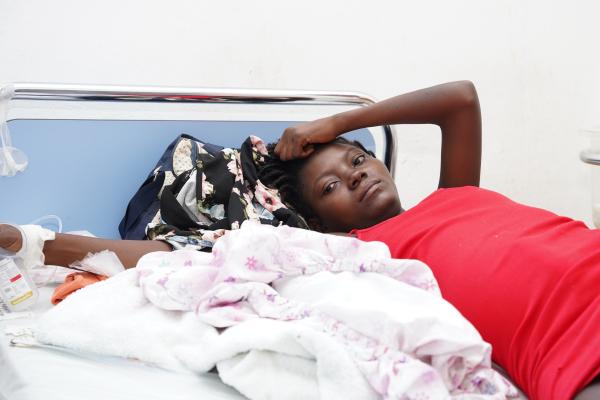
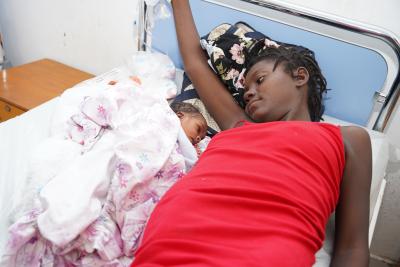
Three days after the birth of her third child, Rival, 25, is recovering from a C-section at Bon Sauveur Hospital in Cange. She says she feels fine and was warmly welcomed by the team that cared for her.
This maternity ward is familiar to her. Rival, who is from a town near Cange, also gave birth to her first two children there. She returns today as a mother of three, this time recovering from a C-section.
She says she is proud to have given birth again at Bon Sauveur Hospital. After the procedure, she needs to be able to rest, receive the necessary care, and remain under observation during her recovery. These conditions are part of postpartum care, but a lack of space had made it more difficult to provide them for some women.
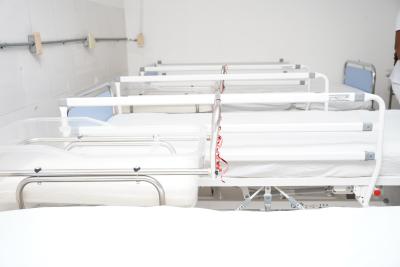
Dr. Fridjof Robergeau, an obstetrician-gynecologist and head of the maternity ward, reports that before the ward’s recent expansion, some women who had just given birth had to wait sitting on a bench when no beds were available. The lack of space also made it difficult to move around, monitor patients, and manage emergencies.
The number of women treated by the department has increased at a time when the region’s maternal care services have themselves undergone changes. Following the closure of Mirebalais University Hospital in March 2025, some of the women who had previously sought care there turned to other facilities, including Bon Sauveur Hospital.
Between July 2025 and June 2026, the HBSC’s maternal and reproductive health services recorded approximately 29,630 patient visits. These include prenatal visits, family planning, gynecological consultations, and deliveries. This figure therefore does not correspond to the number of births, but it provides a measure of the volume of care provided by the teams during this period.
To increase its capacity, the hospital inaugurated a new maternity ward equipped with eight beds on September 3, 2026. The additional space is intended, in particular, to ensure that more women have access to a bed after giving birth and to facilitate the work of the teams responsible for their care.
Rival was among the first women admitted to this ward after it opened. Her situation gives this investment a very concrete meaning. After a C-section, having a bed available means being able to recover in a space designed for that purpose while the medical and nursing staff continue to provide the necessary monitoring.
Her experience is just one among thousands of women treated each year by the hospital’s maternal and reproductive health services. Nevertheless, her story helps us understand what space constraints really mean when the statistics are brought back to the reality of childbirth: a woman has just undergone a surgical procedure, her body is recovering, and she needs a place to receive her care.
Rival has come to know Bon Sauveur Hospital through three important moments in her life. Her three children were born there. For her most recent delivery, she is now recovering in a ward that has eight additional beds. The challenge for the hospital is to maintain these care standards while the number of women turning to the maternity ward remains high.