
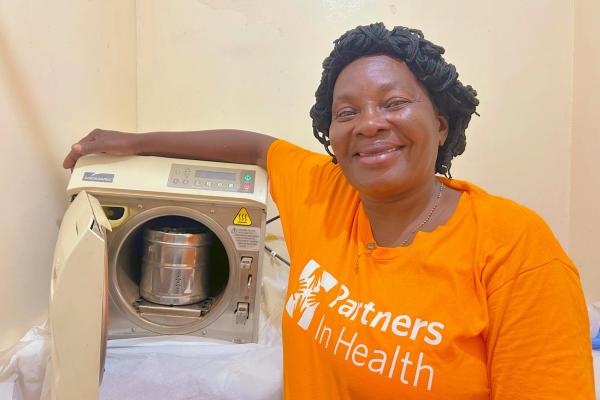
Each month, some 4,050 patients pass through the doors of the Cerca La Source Health Center. They come for emergencies, consultations, childbirth, chronic disease monitoring, vaccination services or HIV and tuberculosis treatment. This constant volume of activity puts continuous pressure on the teams and all the departments, whose ability to function depends on precise technical practices, put in place long before the patient arrives in a treatment room.
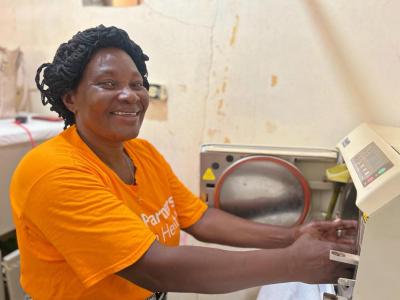
Since 2010, Diena has been working as a sterilization officer at the center. Her role involves preparing and keeping clean the equipment used in all departments. She packages gauze cloths for dressings and procedures, maintains nursing staff gowns and ensures that equipment is available and usable in maternity, emergency, inpatient and other clinical units.
The Cerca La Source Health Center offers a wide range of services: emergency, outpatient clinic, hospitalization, maternity, laboratory, pharmacy, radiology, nutrition, psychosocial services, chronic pathologies, TB/HIV program, community health including vaccination and family planning. The infrastructure includes three general consultation rooms, three hospitalization rooms, two maternity rooms, an emergency room and dedicated areas for each program.
Care is provided by three permanent doctors, twelve permanent nurses and one midwife, supported by intermittent staff, including additional doctors and nurses as required. In this context, the availability of clean, sterilized equipment directly conditions the teams’ ability to provide continuous, safe care.
Sterilization is one of the first barriers against healthcare-associated infections. When this step is insufficient or delayed, patients can be exposed to serious risks, including wound infections, tetanus, hepatitis, HIV or other nosocomial infections. The departments most at risk are emergency, maternity, hospitalization and family planning, where invasive procedures and contact with biological fluids are frequent.
“What motivates me is knowing that my work, however discreet, is essential to caring for and protecting lives. Every effort I make, I make with conscience, out of love for the patients and for the smooth running of the center,” explains Diena.
When sterile equipment is missing or arrives late, the consequences are immediate. Teams become less efficient, certain treatments have to be postponed, infectious risks increase and costs for patients can rise. In the most serious situations, these delays can compromise patient safety and lead to severe complications or even death.
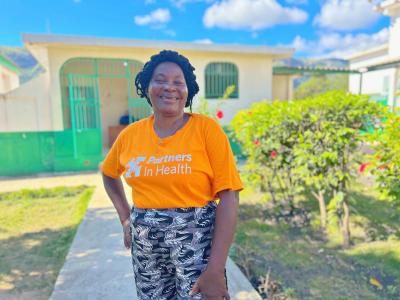
Diena has been confronted with these constraints on several occasions. In 2013, during a critical situation and in the absence of electricity, a patient required an urgent dressing. With no possibility of using the usual equipment, she took the initiative of heating gauze cloths on a charcoal stove to make them usable. This decision made it possible to provide care on time, while limiting the risk of infection.
This type of situation illustrates the reality of sterilization work in a constrained context. This is not a supporting role, but a function integrated into infection prevention and care safety. Every dressing, every delivery, every medical procedure relies on precise preparatory work, often invisible to patients.
Still today, Diena works at the Cerca La Source Health Center, where she continues to sterilize equipment alone. Her work supports all the center’s services and contributes directly to the well-being of patients by reducing avoidable infection-related risks.
At Zanmi Lasante, quality of care is based on rigorous practices, applied at every stage of the care pathway. Infection prevention begins before the medical act. It also depends on those who, upstream, make care possible for thousands of patients every month.
Every dressing, every delivery, every medical procedure relies on precise safety conditions. At Zanmi Lasante, maintaining these standards in a constrained environment requires resources, equipment and constant support. By contributing, you enable teams like those at Cerca La Source to continue protecting patients and ensuring safe care, day after day.