
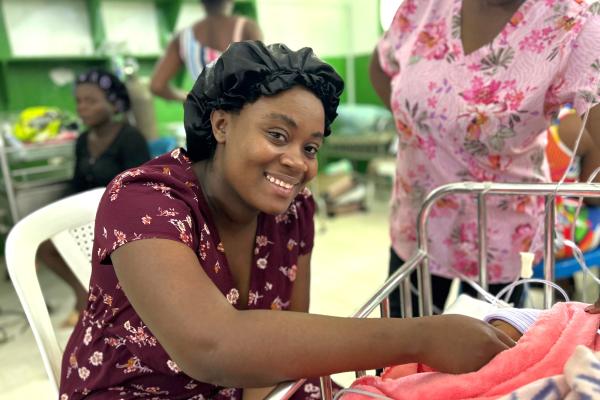
Naïka is 22 years old and already carries a long history of loss. Originally from Port-au-Prince, she left the capital over three years ago to settle in Lascahobas after the violence escalated. This move turned her daily life upside down, but it was above all her interrupted pregnancies that left their mark on her body and mind.
Naïka lives with polycystic ovary syndrome. This hormonal disorder disrupts ovulation and can make pregnancies difficult to maintain. It often causes irregular cycles, hormonal disorders and an increased risk of miscarriage. For Naïka, this meant five lost pregnancies. Some stopped very early. Others later, always abruptly. In one case, an emergency Caesarean section was performed for extreme prematurity. The baby did not survive.
“Every time I got pregnant, I hoped. And every time, I lost the baby,” she recounts. “After a while, you start to wonder if your body can ever go all the way.”
In 2025, she became pregnant a sixth time. At the time, she was being monitored at the University Hospital in Mirebalais. After the services were discontinued, her medical care was suddenly interrupted. For an already fragile pregnancy, this break created a new uncertainty.
Naïka then presented herself at Hôpital Notre-Dame de la Nativité de Belladère, a Zanmi Lasante network facility, where she was integrated into the prenatal consultation circuit. From the very first assessment, the team identified a high risk of further loss. Her history was clear. Several miscarriages. A previous caesarean section. Signs of premature cervical opening.
Dr. Denaud Jean Alix, gynecologist-obstetrician, remembers this first encounter.
“She’d already been through everything. Five pregnancies, five failures. She came with a very specific fear: to go through the same thing again.”
Follow-up is organized around close prenatal consultations and close monitoring. The objective is simple and demanding: to prolong the pregnancy week after week. Two cervical cerclages are performed to prevent premature opening of the cervix. The first is performed by Dr Denaud Jean Alix. The second is performed later by Dr. Eddy Léandre, also an obstetrician-gynecologist at the hospital.
“It wasn’t an exceptional decision,” explains Dr. Léandre. “It was what her background dictated. When you see his history, you know that you have to act early and follow very closely.”
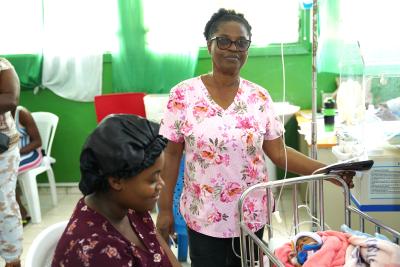
Between medical consultations, the Santé Fanm nursing team provides constant support. Nurses take the time to re-explain instructions, check warning signs and respond to the concerns of a patient who has learned to associate pregnancy with loss.
“She needed to be spoken to clearly,” explains Benitha Germain, nurse in charge of Santé Fanm at HNDN. “No promises. Just serious follow-up, and someone to respond when she’s worried.”
A little over seven months into her pregnancy, Naïka presents with premature labor. A Caesarean section is decided. The operation is performed by Dr Léandre. This time, the baby is born alive.
After the birth, Naïka sends a message to Dr Alix.
“Yon lòt fwa mil mèsi, Doktè. M pa konn kijan pou m di sa m santi. Ou te toujou la, menm lè ou pa t la. Fwa sa a, se kri lajwa.”
Today, Naïka holds her child in her arms. This outcome is based on clinical decisions taken at the right time, close coordination between caregivers and rigorous prenatal monitoring right up to delivery.
Courses like Naïka’s remain fragile. They require trained teams, equipment, medical and nursing time, and continuity of care despite interruptions and forced displacements. Supporting this care means enabling other women to benefit from the same specialized follow-up.