
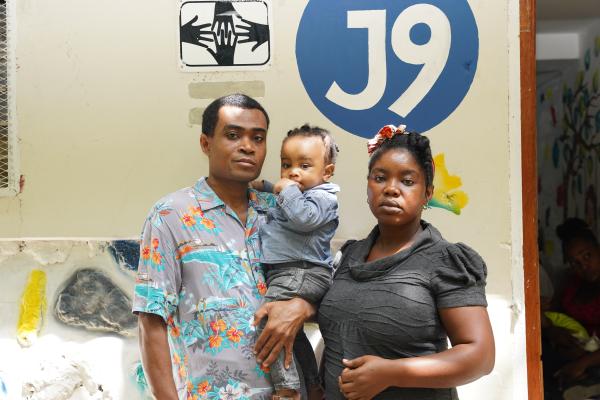
Rodrique works in agriculture. Trained as an agricultural engineer, he also teaches. His wife, Florene, is a professional gardener and currently works in sales. Together, they are raising two children: Rodjine-Flore, their five-year-old daughter, and Florventz, their fifteen-month-old son.
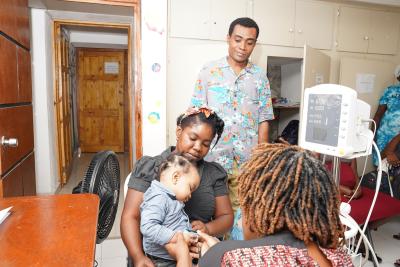
Their journey with Zanmi Lasante’s J9 program began at Mirebalais University Hospital during the pregnancy of their first child. A nurse told them about the program, explained the available services, and encouraged them to enroll in the program right from the start of the pregnancy. For Florene, this initial experience helped build a relationship of trust with the staff. She discovered a place where pregnant women received not only medical care but also practical information on nutrition, infant care, postpartum behaviors, and key stages of child development.
Rodjine-Flore received care in Mirebalais until she completed the program. Rodrique recalls this initial journey as a learning experience. His role, he says, was to support his wife during pregnancy and after the birth. He followed the advice given by the nurses, especially regarding nutrition, child care, and medical follow-up. His support didn’t rely on grand speeches. It was evident in the appointments they kept, the recommendations they followed at home, and the attention they paid to their daughter’s development.
When Florene became pregnant with their second child, the experience they’d gained with Rodjine-Flore proved invaluable. The family was already familiar with how J9 worked. Rodrique had a better understanding of the importance of the visits, the advice received, and the role a father can play in his family’s healthcare journey. Florventz was cared for at Bon Sauveur Hospital in Cange, under much more difficult circumstances.
This second pregnancy was marked by an episode of eclampsia. It also took place at a time when the attack by armed groups in Mirebalais on March 31, 2025, disrupted living conditions and access to health services for many families. Despite this unstable period, Florene continued to receive support from the J9 program. For her, this support helped the family navigate a high-risk pregnancy and continue Florventz’s follow-up care after her birth.
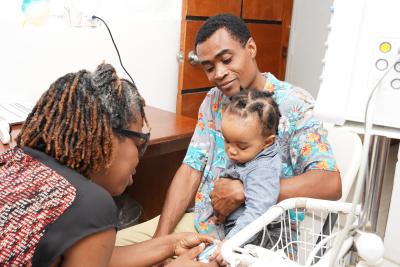
Zanmi Lasante launched the J9 program in March 2018 at the Mirebalais University Hospital to help reduce maternal and child morbidity and mortality. The program is based on four pillars: group prenatal care, group pediatric care, psychosocial services, and community-based care. It aims to reduce wait times, improve adherence to appointments, increase the number of institutional deliveries, and improve postnatal follow-up for children.
Since its launch, J9 has enrolled approximately 8,625 pregnant women and provided pediatric follow-up care for 7,094 infants. Seventeen cohorts have already graduated in Mirebalais, Hinche, and Cange. The program has an 85% retention rate, with 86.85% adherence to prenatal visits, 81.95% to postnatal visits, 78.4% to pediatric visits, and 92% of births taking place in healthcare facilities.
These figures take on real meaning in a family like Rodrique and Florene’s. A scheduled prenatal visit can help identify a risk earlier. A postnatal visit can help a mother better understand her baby’s condition. Regular pediatric follow-ups can help monitor growth, vaccinations, breastfeeding, and signs that require immediate attention. When both parents understand this information, health decisions become more collaborative.
Florene says that J9 helped her a great deal during her pregnancies and after the birth of her children. She participated in training sessions on nutrition, infant care, and practices that promote healthy growth. After giving birth, healthcare providers also advised her on how to take care of herself and her children. This support gave her more confidence in her ability to protect their health.
The program doesn’t end at the hospital. Home visits allow the teams to better understand the conditions in which mothers and children live. Community health workers serve as a link between families, the J9 team, and health facilities. They raise awareness among women, facilitate home visits, support communication with providers, and help locate patients who have been lost to follow-up.
This close involvement can change the outcome of a pregnancy. The J9 team cites the case of Ms. Vilbréus Anne Marie, 37, who has hypertension and a history of multiple pregnancy losses related to high blood pressure. As soon as she joined the program, she received preventive treatment, psychosocial support, and home visits. During a visit at 36 weeks, the team detected very high blood pressure. She was immediately referred to the maternity ward. An emergency cesarean section resulted in the birth of a live baby girl who appeared to be in good health.
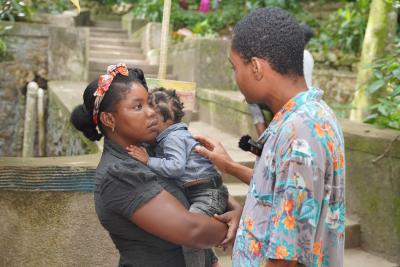
Florene’s experience gives particular significance to this type of care. Her second pregnancy involved a serious risk. Amid the crisis, she continued to receive care, guidance, and follow-up that enabled her family to remain connected to the healthcare system.
The results observed by the J9 team confirm the importance of this model. Since the program’s inception, the team has noted a decline in the preterm birth rate, a decrease in admissions of newborns to neonatal intensive care units, improved adherence to prenatal, postnatal, and pediatric checkups, an increase in institutional deliveries, greater acceptance of family planning after childbirth, and an increase in exclusive breastfeeding. For children, J9 also helps improve vaccination coverage, growth monitoring, and the prevention of malnutrition.
For Rodrique, these two experiences have reinforced a simple conviction: the father plays a concrete role in the health of the mother and children. His presence does not replace that of healthcare providers. It helps put advice into practice at home, support the mother, keep appointments, monitor the child, and participate in decision-making when a situation is cause for concern.
For Florene, the difference between the two experiences also lies in the context. The first pregnancy proceeded without major complications. The second required more attention, greater vigilance, and more support. The J9 program maintained contact with her at a time when the family needed it most.
Florventz is now preparing to graduate from the program. This graduation marks the end of a cycle of care, but it also tells another story: a family that has gone through two different experiences, a first journey that prepared the way for the second, a mother supported during a high-risk pregnancy, a father more involved in health practices, and two children who benefited from support from the very first months of their lives.
The current context continues to complicate the teams’ work. The sociopolitical situation has led to the temporary closure of operations in Mirebalais, the reassignment of J9 staff members, the setup of a new space in Cange, and the search for solutions for Hinche.
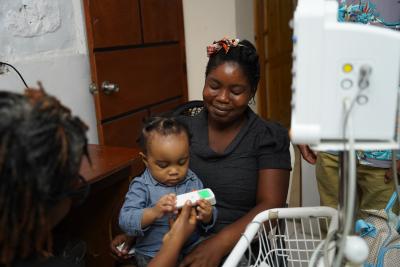
This reality lends even greater significance to the journeys of Rodrique, Florene, Rodjine-Flore, and Florventz. It serves as a reminder that J9’s results do not stem from a single intervention. They stem from a model that integrates consultations, education, psychosocial support, home visits, community work, and family participation.
Since 2018, more than 8,600 pregnant women and more than 7,000 infants have been enrolled in this model. Behind these numbers are mothers learning to better recognize risks, children whose growth is being monitored, families who better understand their appointments, fathers taking on a more active role, and teams that continue to work despite the challenges.
Florventz’s graduation tells this story on a family level. Rodjine-Flore paved the way. Today, Florventz is completing her own journey. Rodrique and Florene are leaving with knowledge, skills, and experience that will continue to live on in their home, long after the ceremony.
Your support enables Zanmi Lasante to continue supporting pregnant women, mothers, newborns, and families who need regular, safe, and accessible care. By donating today, you help protect the health of mothers and children, strengthen services at Zanmi Lasante’s sites, and support families like Rodrique and Florene’s.