The work around the projects financed by FAES with the support of the IDB and carried out by Zanmi Lasante is based above all on a concrete question: how to enable families already weakened by poverty, illness or isolation to continue to access healthcare despite the country’s current crisis?
hospital
Every day, patients arrive at Hôpital Sainte-Thérèse after several hours’ travel, sometimes with no money to pay for transport or buy something to eat after a consultation. Many live in remote rural areas where access to health services remains limited. For these families, receiving a diagnosis or a prescription is not always enough. They also need to be able to return for the next appointment, feed the children, maintain a course of treatment or simply get through a difficult period without tipping further into precariousness.
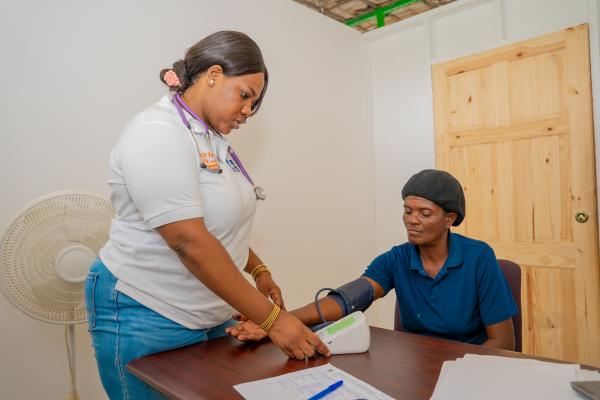
This is the logic behind the third cohort of the HA-J0005 project. In the ten communes covered by Zanmi Lasante, 5,416 people are targeted as part of this cohort. The Hinche site cares for 800 beneficiaries. Every day, more than 80 people receive services including medical consultation, social accompaniment, food kits and financial assistance provided under the program.
Beyond the numbers, the project relies on extensive fieldwork. Field agents, community surveyors, social workers, medical teams and members of the Noyau Éducatif Communautaire work together to identify the most vulnerable households and ensure their follow-up. This coordination helps maintain a link between rural communities and healthcare structures, even in difficult contexts.
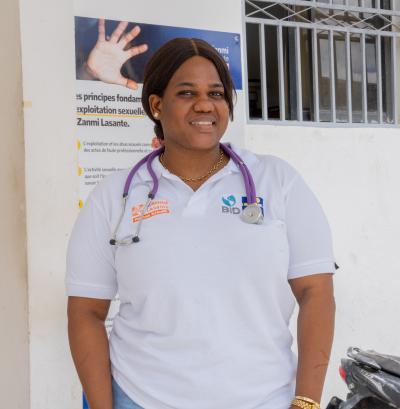
Dr. Dronette Greuze B.J., technical officer for FAES-BID projects, is one of the people who ensure this coordination on a daily basis. She supervises the outpatient doctors, supports the teams and ensures the quality of care at the Hinche site. Her job is also to ensure that beneficiaries can actually access the planned services and continue their medical follow-up.
“Many families arrive with several difficulties at the same time. Some people need care, but also support to be able to continue their treatment or meet urgent needs at home. The project helps to maintain this link with care,” she explains.
Odina’s journey illustrates this reality. Aged 56, mother of six, she has taken on the responsibilities of the household almost single-handedly since her husband lost his sight over three years ago.
Like many families living in rural areas, Odina had to manage food expenses, health needs and daily burdens all at once with very few resources. Community interviewers identified her during targeting activities carried out in her area. After evaluation, she was selected as a beneficiary of the third cohort of the HA-J0005 project.
She received a medical consultation at the Sainte-Thérèse hospital in Hinche and joined the support scheme provided by the program.
“Frankly, it had been a long time since I’d had access to healthcare. When I found out I’d been selected for the project, I felt great joy,” she recounts.
In addition to the consultation, Odina benefits from a food kit and a monetary transfer designed to support her household during this difficult period. She hopes to use this aid to meet her children’s immediate needs and develop a small income-generating activity.
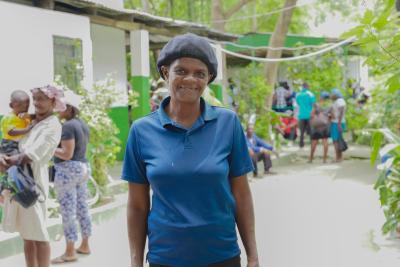
“With this aid, I’ll be able to take better care of my children. I also want to start a small business to begin earning a living.”
Through this program, Zanmi Lasante continues its outreach work with families facing multiple vulnerabilities. Needs remain great, however, particularly in rural areas where access to healthcare remains fragile and many families continue to live without regular support.
FESA funding with IDB support is now enabling thousands of people to access essential care and support. But humanitarian and health challenges persist.Supporting this type of initiative means enabling more families like Odina’s to receive care, maintain their dignity and build sustainable solutions to precariousness.