
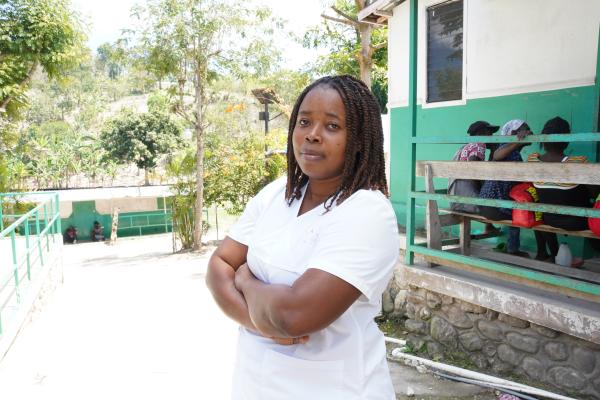
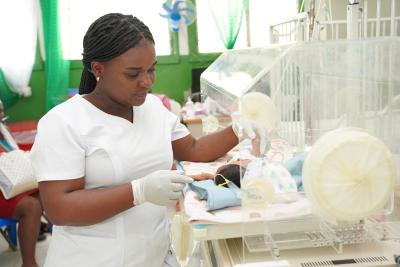
A 15-day-old newborn arrives at the emergency room in critical condition. He is suffering from severe dehydration. His skin is dry and wrinkled, his eyes are sunken, his condition requires rapid intervention. Several attempts to insert a venous line have already failed. Venous access is difficult. Time is of the essence. Venise Soy, a nurse on duty in the pediatric ward at Hôpital Notre-Dame de la Nativité in Belladère, was called in to help. She entrusts her shift to another nurse, joins the emergency team and manages to install the venous line. The baby was able to receive the necessary care in time. His mother thanks her again and again. Venice replies: “I was just doing her job.”
Venise Soy, infirmière de ligne au service de pédiatrie de l’Hôpital Notre-Dame de la Nativité de Belladère.
This sentence carries all the restraint of the profession. Life-saving gestures are often part of the ordinary language of duty accomplished. They are a matter of acquired skill, clinical judgment, a calm built by experience and an ability to act at the exact moment a patient’s condition demands.
International Nurses Day 2026 carries a clear theme: “Our nurses. Our future. Nurses’ power to act saves lives.” For Zanmi Lasante, this theme finds its strength in the daily work of the nursing teams who hold wards, accompany patients and participate directly in safe care.
Venise Soy knows this responsibility on a daily basis. She has been working at Zanmi Lasante for around six years. After three years in the COVID-19 program, she joined the pediatric department, where she accompanies children and their families. Her department is now receiving an increasing number of patients, mainly due to the massive repatriation of families from the Dominican Republic and the closure of the Mirebalais University Hospital. This pressure also affects pregnant women who come to Belladère seeking care and safe accompaniment.
His experience with newborn babies shows what the power to act enables when the emergency becomes concrete: a rapid decision, immediate coordination, a successful technical gesture, treatment made possible. The quality of care then depends on a professional’s ability to intervene at the right time, with the necessary skills and the team’s confidence.
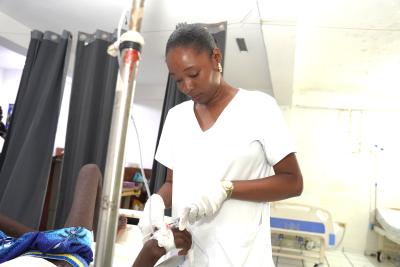
Lory Dana Claudius Norcius travaille comme infirmière de ligne au service de chirurgie de l’Hôpital Bon Sauveur de Cange.
Lory Dana Claudius Norcius carries this same requirement to the surgery department at Hôpital Bon Sauveur de Cange. Her journey began with a six-month internship in 2019, followed by a period of volunteering, then a position as internship instructor from 2020 to January 2024. Since February 2024, she has continued her work as an employee of Zanmi Lasante. Her experience combines caring for patients, mentoring student nurses and a sustained focus on the quality and safety of care.
Surgery gives special shape to the power of action for nurses. A change in pain, a fever that sets in, a wound that’s not progressing well, a drain to watch out for or a complication that starts quietly can alter a patient’s course. Lory works in this zone of vigilance, where recovery depends on the precision of monitoring, the quality of transmissions, infection prevention, pain management and the ability to alert the medical team at the right time.
The department where she works carried out 585 surgical procedures in 2025, including 354 major cases. It also welcomed over 1,759 outpatient consultations and maintained a mortality rate of 1.5%, despite the complexity of many of the cases treated. These results are based on an entire chain of care: patient preparation, post-operative monitoring, hygiene, documentation, coordination and follow-up.
Lory remembers a 20-year-old man who arrived from the emergency department with generalized peritonitis. His condition required the mobilization of doctors, nurses, orderlies, the operating room team and housekeeping staff. After two months in the surgical ward, he was discharged alive. This case shows another dimension of theme 2026: the power to act also saves lives through duration, when the team maintains surveillance, care and accompaniment until the possible return home.
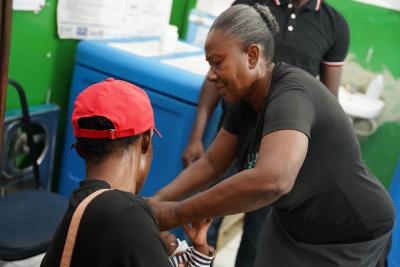
Marthe François José fait partie de Zanmi Lasante depuis 20 ans et travaille actuellement comme responsable du Programme Élargi de Vaccination à l’Hôpital Notre-Dame de la Nativité de Belladère.
Marthe François José brings a third reading to this theme. Head of the Expanded Immunization Program at Hôpital Notre-Dame de la Nativité in Belladère, she has been working at Zanmi Lasante for 20 years. Her role acts before the emergency: informing parents, monitoring children’s vaccination, spotting danger signs and rapidly referring patients requiring specialist care.
A five-month-old infant received in consultation marked her journey. The child presented with a temperature of 38°C, a respiratory rate of 60 movements per minute, generalized edema and an oxygen saturation of 94%. Marthe immediately referred him to the pediatric emergency department. It was a case of severe malnutrition accompanied by respiratory distress. The child spent two days in the emergency department, then four weeks in hospital. Later, Marthe saw the mother and her baby in better health.
The journeys of Venice, Lory and Marthe give a concrete reading of the power of action of nursing staff. This power is based on training, experience, service organization, trust between colleagues, access to equipment and the place given to nurses in care decisions. It becomes visible when a newborn receives treatment on time, when a surgical patient makes it through two months of hospitalization, when a child at risk is identified before his or her condition worsens further.
International Nurses Day 2026 invites recognition of this work. Zanmi Lasante nurses give services their daily capacity for action. They connect patients to care, families to information, emergencies to treatment, prevention to health outcomes.
Supporting Zanmi Lasante means supporting the teams that make this care possible. Your contribution helps maintain services, accompany patients, strengthen health structures and give nurses the means to continue saving lives in the communities that need it most. Make a donation to support essential care in Haiti.