

Health teams in Haiti operate in an environment that imposes constant and prolonged pressure. Travel can become uncertain from one day to the next, rumors circulate rapidly and influence local decisions, structures must absorb an increase in demand with limited resources, and professionals must continue to provide precise care in conditions that demand constant vigilance.
This accumulation of constraints produces concrete effects on caregivers. Stress is not confined to one-off episodes; it sets in over time and gradually alters coping capacities. Fatigue becomes persistent, even after periods of rest. Concentration requires greater effort. Clinical decisions have to be taken in a state of tension that becomes habitual. The body remains alert, affecting sleep, recovery and emotional stability.
The dynamics observed at national level reinforce this pressure. Population displacements, service interruptions and rapid changes in the security situation place an additional burden on healthcare structures, which must continue to operate despite these constraints.
A recent episode at the Centre de Santé Saint-Michel, in Boucan Carré, provides an insight into how these tensions manifest themselves in concrete terms. A rise in tension linked to the attempted forcible extraction of a patient by an armed group led to an evacuation of staff and temporary closure of the center. The teams had to take cover at very short notice, interrupting services before a gradual resumption a few days later.
Consultations resumed rapidly after the reopening. Patients returned, often with needs unchanged or aggravated by the interruption. Teams resumed their posts with the same clinical responsibility, in an environment that remained fraught with tension.
The effects of the event remained present in day-to-day operations.
“Lè m tande rimè yo, kè m te bat fò. Mwen pa t ka konsantre sou travay mwen. Men lè nou pale ansanm, mwen konprann reyaksyon sa yo nòmal.”
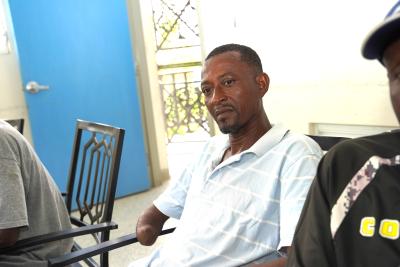
Exchanges organized with staff at the Boucan Carré health center identified specific manifestations of stress. Several staff members described difficulty concentrating during consultations, a feeling of loss of control at the time of events, persistent sleep disturbances, palpitations and a sense of insecurity that did not immediately disappear once activities resumed.
“Evakyasyon an te difisil. Mwen te santi m pèdi kontwòl. Jodi a, mwen wè mwen pa t pou kont mwen.”
These reactions correspond to repeated exposure to demanding situations. Teams are not faced with a single isolated event, but with a succession of constraints that constantly challenge their ability to adapt. In this type of reality, fatigue becomes a structuring factor in the work, and stress directly influences the way care is delivered, particularly in busy or emergency moments.
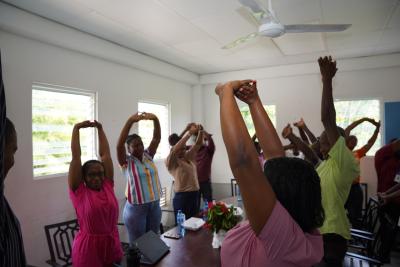
Psychosocial support activities have been set up to enable staff to look back on events, understand their reactions and have concrete tools to manage the effects of stress in their daily lives. Sharing experiences with colleagues brought to light similar experiences and reduced feelings of isolation.
Breathing and relaxation exercises were introduced to help reduce immediate tension and facilitate a gradual return to a level of concentration compatible with clinical activity.
Measures have also been initiated to improve working conditions at the Boucan Carré health center. Enhanced psychosocial support, logistical adjustments, the availability of resources when needed, and improvements to certain equipment are helping to stabilize site operations. These elements directly influence the teams’ ability to maintain their presence and ensure continuity of services.
The discussions also highlighted issues relating to cohesion and the flow of information between staff members. These aspects play a direct role in site stability and teams’ sense of security, particularly in environments where perceptions of risk change rapidly.
Work continues at the Boucan Carré health center. Patients continue to be cared for. Teams provide consultations, follow-ups and emergencies in an environment that remains demanding.
This continuity relies on professionals exposed to prolonged pressure, whose ability to remain on the job also depends on the responses put in place to accompany stress, limit fatigue and preserve the quality of care.
Supporting Zanmi Lasante means supporting the teams who provide care in demanding conditions. Your contribution helps to strengthen psychosocial support, improve working conditions and maintain access to care for communities.