
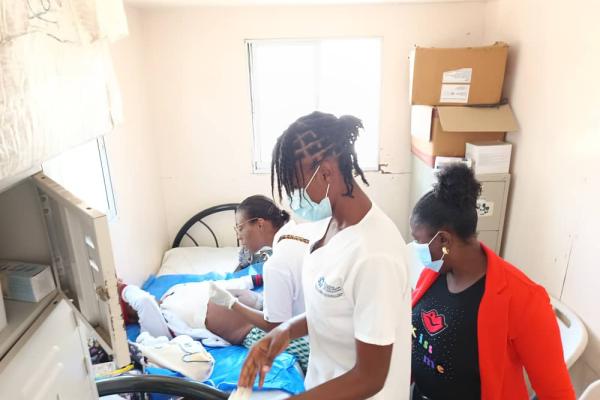
Zanmi Lasante maintains a reception, assessment and orientation facility in Belladère, a commune on the border with the Dominican Republic. This mechanism, supported by FAES, identifies and takes care of urgent medical cases among the thousands of Haitian nationals who arrive each month in vulnerable situations.
Elda, 28, is a young Haitian woman living in the Dominican Republic. She was hospitalized for a caesarean section complicated by pre-eclampsia. A few days after the procedure, while still recovering from the operation, she was deported and dropped off at the border point by the migration police, along with her newborn.
She had just given birth. Her body was still fragile. The surgical scar required regular care. Her blood pressure had to be monitored. Her child, on the other hand, was in good general condition.
The border cell team immediately assessed her on arrival. Examination revealed early signs of infection at the surgical wound. Her history of pre-eclampsia also required strict blood pressure control to avoid complications.
Caregivers cleaned and treated the wound, monitored her blood pressure and checked the newborn’s health. Front-line psychosocial support was offered to accompany her through a time marked by uncertainty. Before her departure, a clear referral to medical follow-up was organized to guarantee continuity in her convalescence.
Since 2020, the border system has evolved to respond to the increase in refoulements and the complexity of the situations encountered. On average, almost 9,000 nationals are received every month. During each wave of deportations, 5 to 6 cases present a high medical risk, particularly post-partum women or people requiring immediate stabilization.
The program operates in coordination with the Ministry of Public Health and Population, the Pan American Health Organization and the World Health Organization, to ensure a response aligned with national public health standards.
This type of situation recurs regularly in Belladère. The system supported by FAES makes it possible to intervene as soon as refused patients arrive, prevent avoidable complications and ensure continuity of care in a context marked by sudden breaks in care.
Each month, thousands of nationals arrive in Belladère in highly vulnerable situations. Among them are recently operated patients, post-partum women, people with chronic illnesses or requiring immediate stabilization.
Your support helps ensure that these patients receive essential care when they need it most. Support emergency care and continuity of services in Haiti.