
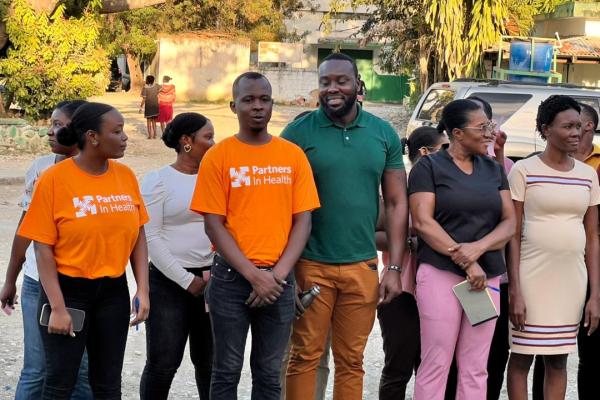
In December, nineteen managers and healthcare professionals from several Zanmi Lasante network sites gathered at the Centre National de Formation in Hinche for training in social medicine. For several days, they worked on situations close to those encountered in their daily practice, where a health problem is part of trajectories marked by economic precariousness, isolation, social relationships, family obligations and the limits of the organization of care.
The training took place from December 15 to 19. Dr. Fernet Léandre, Senior Health and Public Policy Advisor at Partners In Health, led the sessions alongside medical and educational executives from the network. Participants covered clinical, nursing, community, social and administrative functions. This common framework made it possible to analyze care situations from several levels of intervention, as they concretely intersect in the field.
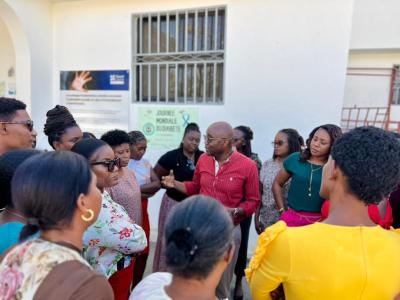
This diversity reflected a daily reality in the country’s hospitals and health centers, where the quality of follow-up depends as much on the prescription as on the system’s ability to accompany a person over time. Discussions focused on how clinical decisions relate to the organization of services, the availability of resources and the constraints that patients face on a daily basis.
The first few days were devoted to analyzing trajectories inspired by real cases. Participants worked on patient journeys faced with successive obstacles: unforeseen transport costs, unstable incomes, administrative delays, medication shortages, family responsibilities, experiences of discrimination or insecurity. These situations served as the basis for an analysis of structural violence, the social determinants of health, the intersection of discrimination, human rights and gender-related power relations, based on observable facts.
Based on these trajectories, discussions focused on the concrete conditions that influence adherence to treatment, regularity of follow-up and the relationship between patients and healthcare teams. Participants analyzed how these constraints accumulate over time and modify healthcare choices, sometimes well before the consultation.

Participants then visited patients in their living quarters, in Cherival and Fort Résolu. They met people being monitored for non-communicable diseases, as well as women benefiting from family planning services. These visits enabled them to observe how material conditions, household organization, access to water, electricity, transport or support networks influence day-to-day health decisions.
In Cherival, a middle-aged woman being followed for hypertension after a stroke presented a stabilized clinical situation. Discussions highlighted an environment marked by strong community solidarity, combined with persistent difficulties in accessing specialized care and medical coverage mechanisms. Continuity of care depended on a delicate balance between the organization of services and available resources.
In another household in the same area, a man living with diabetes had adequate housing and solid social ties. His care pathway remained marked by experiences of discrimination, episodes of violence and recurring financial difficulties in purchasing medication. The discussion focused on how these experiences influence the care relationship and the ability to maintain treatment over time.
At Fort Resolu, participants met a widowed woman, head of household, living with eight dependents in extremely vulnerable conditions. The household had no stable access to water, electricity or sanitary facilities. The patient was coping with a recent injury with limited access to care. This situation highlighted the close interweaving of medical care, social protection and community support in contexts of extreme precariousness.
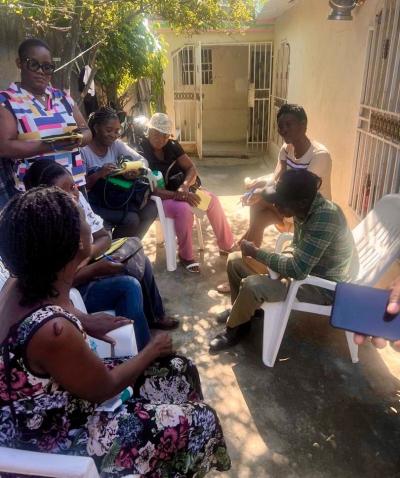
The collective restitutions enabled participants to share their observations and analyze possible responses at site level. Discussions focused on adapting monitoring practices, coordinating teams and integrating social constraints into care decisions.
At the end of the training, several managers identified concrete situations at their sites where the approaches worked on could be put into practice. Some have begun adapting the tools used during the training with their local teams, particularly in the monitoring of chronic illnesses, community support and coordination between services.
“This training has given us concrete tools to apply social medicine at our respective sites. It strengthens our ability to adapt follow-up to the realities experienced by patients,” confides a Zanmi Lasante executive.
A session devoted to gender equity and the prevention of sexual abuse and exploitation completed the training. Discussions were based on situations encountered in daily practice, linked to access to care, patient safety and the power dynamics observed in the field.
This national training laid operational foundations for a practice better aligned with the realities experienced by patients. In a healthcare system under strain, this work of analysis and transmission directly influences the way care is organized and monitored on a daily basis.
The situations observed in Cherival and Fort Résolu show how living conditions directly influence access to and continuity of care. Your financial support makes it possible to maintain these grassroots approaches and accompany patients over the long term.