Fiscal Year 2027 begins after several years that have put the organization to the test, but which have also confirmed its ability to adapt, maintain access to essential care, and continue its mission despite exceptional circumstances.
The challenges have not disappeared. However, they have forced us to reevaluate ourselves, review certain practices, strengthen our management systems, and uphold our commitments to patients in a context that remains demanding. The challenge ahead is no longer simply to maintain our services. It is now to consolidate our achievements, to correct without complacency what needs to be corrected, and to prepare the organization to respond with greater efficiency, discipline, and resilience to the realities of tomorrow.
Since the suspension of services at Mirebalais University Hospital in 2025, Zanmi Lasante has had to rethink a significant part of its organization. This suspension had profound consequences for patients in need of specialized care, for the teams working there, and for the entire referral system that we had helped build. It also underscored the irreplaceable role that HUM played in managing complex cases, training healthcare professionals, and advancing clinical excellence in Haiti.
During the past fiscal year, the organization continued its efforts to strengthen facilities capable of treating more patients, bring certain services closer to communities, and preserve the clinical expertise necessary for the continuity of programs. This work remains essential, as the needs show no sign of diminishing. Every day, families continue to rely on us when a child is sick, when a pregnant woman needs safe prenatal care, or when a patient living with a chronic illness must continue their treatment without interruption.
The new fiscal year should enable us to go even further. We must better organize available resources, better anticipate needs, strengthen ties between departments, and improve the coordination of care so that every patient can be referred, monitored, and treated with greater continuity, speed, and quality.
This ambition requires rigorous organization and a culture of accountability at all levels. The quality of care does not depend solely on clinical expertise. It also depends on the quality of decisions made upstream, the rigor of our management, and our ability to effectively carry out our priorities. Better planning, responsible resource management, rigorous risk monitoring, and robust control mechanisms are not merely administrative goals; they are essential conditions for safeguarding the continuity of care and the trust that patients place in us.
Institutional discipline is not an option, much less a bureaucratic constraint. It is a management imperative and a duty to the patients we serve. It enables us to better anticipate needs, reduce avoidable disruptions, track commitments, prevent abuse, and ensure the responsible use of every resource entrusted to the organization. In an environment marked by limited resources and immense needs, we must demonstrate zero tolerance for waste, improvisation, and practices that compromise our collective effectiveness.
We must also strengthen our ability to respond when conditions change abruptly. This requires better-coordinated services, fully operational continuity plans, stronger regional capabilities, more secure supply chains, and a culture of constant preparedness. Our responsibility is to ensure that teams can continue to work and that patients can continue to receive care, even under the most difficult circumstances.
The Mirebalais University Hospital remains a major landmark in the history, identity, and future of Zanmi Lasante. HUM has provided thousands of patients with access to specialized care that remains difficult to find elsewhere in the country. It has also trained several generations of professionals and made a decisive contribution to strengthening the Haitian healthcare system.
Zanmi Lasante will continue to defend the strategic importance of HUM and actively advocate for its future. However, we must also recognize that our responsibility to patients requires us to continue strengthening the network’s other sites so that more people can receive quality care in facilities that are more accessible to their communities. This approach does not replace HUM’s role; it is a responsible response to current needs while preserving our long-term vision.
The new fiscal year will also be a pivotal period for the Zanmi Lasante teams. The quality of our work depends on the women and men who care for patients, organize services, support families in their communities, perform laboratory tests, ensure supplies, manage operations, and support program implementation.
These teams have courageously shouldered much of the change the organization has undergone in recent years. They deserve to work in an environment that is clearer, safer, more equitable, and better structured. We must invest more in their development, strengthen leadership capacities, support the next generation of leaders, and promote a culture based on performance, integrity, continuous learning, and accountability.
This year must also strengthen our ability to work with institutions and partners who share our commitment to health in Haiti. The Ministry of Public Health and Population, universities, technical and financial partners, the diaspora, and local communities remain essential stakeholders. No sustainable progress can be achieved without close, transparent, and results-oriented collaboration.
We are approaching this new fiscal year with a clear-eyed perspective. Needs remain considerable, while available resources are more limited and uncertainties surrounding health financing remain significant. This reality will require us to make difficult choices, set clear priorities, and use every dollar, every piece of equipment, and every hour of work with the utmost sense of responsibility.
However, this reality must never serve as an excuse for mediocrity or complacency. Patients who place their trust in Zanmi Lasante are entitled to quality care, delivered with competence, respect, compassion, and professionalism. Our collective responsibility is to focus our efforts on what makes the greatest impact, to strengthen the quality of our services, and to continuously improve outcomes for patients and communities.
Our ambition is to build an organization that is more disciplined, more transparent, more accountable, more efficient in its operations, and more demanding of itself—an organization that measures its results, assumes its responsibilities, quickly addresses its weaknesses, and consistently places patients at the center of its decisions.
Zanmi Lasante moves forward with a simple yet fundamental conviction: every improvement in how we plan, manage our resources, collaborate, and report must translate into a tangible improvement in patients’ lives. Only then will we fully honor our mission and build a stronger, more equitable, and more sustainable healthcare system for the communities we serve.
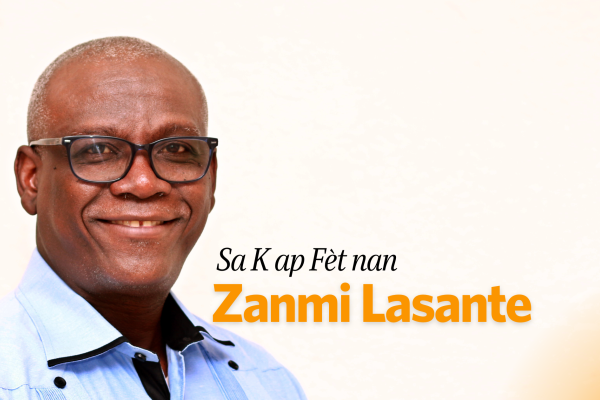
Wesler Lambert, MD, MPH
Executive Director, Zanmi Lasante